
Your Partnership
Is an Asset.
Build It Like One.

Sunny Sabbini is a partnership advisor in the San Francisco Bay Area working with
business partners and cofounders whose partnership has outgrown how it was set up.
Partnership Coaching and Advisory for Business Partners Who've Outgrown Their Original Design
You’ve built the business deliberately, but the partnership has been running on agreements you set up in year one. Those agreements hold until growth, pressure, or a transition asks it for something new, something it wasn’t designed for.
Partnership Coaching builds the partnership itself, so that it. holds under pressure, adapts through a transition, and keeps developing at the pace of the business. .
Expand capacity before you need it. Don’t wait for a crisis to break what you’ve built.
Take the Partnership Capacity Check Ten minutes. Two timelines: what's changed in the business and what hasn't changed in the partnership.
Sunny Sabbini is a partnership advisor in the San Francisco Bay Area. Through ASCENT Partnership she builds the decision rights, role clarity, and operating rhythm a partnership needs to keep pace with the business.
If you've been nodding through this, take the 10-min Partnership Capacity Check. You'll leave with specific structural language for what's been driving the friction, and will tell you where to start.

The Friction Isn't the Problem. It's the Signal.
What wears on you most isn't the occasional stalemate, it's more subtle than that.
You make a decision and you both walk out of the room thinking it's done. But a week later it's somehow back in question.
You did the offsite and you left with real clarity. A month later, you honestly couldn't tell it had ever happened.
One of you has taken on more work than your share. It’s started to grate, but neither of you has said it out loud.
There's a conversation the two of you keep almost having and then not having, the one you've both learned to step around.
There’s an agreement you made at the very beginning that no longer matches how you actually work.
So you've added meetings. Added documents. Added check-ins. But the underlying feeling that something’s not working hasn't moved.
Not Broken. Not Failing. Underbuilt for the Business It's Becoming.
None of this means the partnership is failing, or that one of you is the problem.
When the business was newer, the complexity was lower, so the informal agreements held. You both had capacity to see everything that was happening in the business, so proximity covered the gaps. Then the business grew, and with it the stakes: more money riding on each decision, more consequence per call. But the agreements didn’t change.
The partnership is an asset, the same way the business is. Just like the business, it doesn’t grow on its own, just because the thing around it did. The distance between what the partnership was built to carry and what it is now being asked to carry keeps growing . Not all at once, but a little with every hire, every new line of work, every decision that matters more than the last one did.
The partnership hasn't kept pace with the business.
Coaching Addresses the Whole System, Not Just the Symptoms
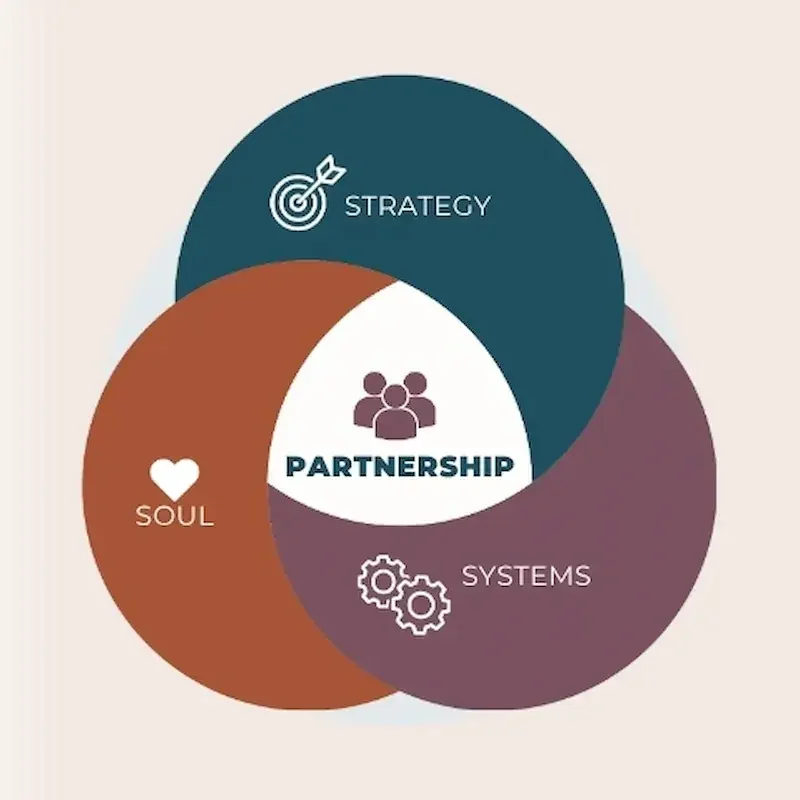
Building a partnership that holds means working three dimensions at once: strategy, systems, and soul. Working one without the others is likely why previous attempts didn't last.
Strategy. The direction each of you is building toward, and whether it's still your shared goal. Two partners can agree on the next quarter and disagree on the next five years without either of them knowing it. Focus on strategy surfaces what each of you is actually building toward and then reconciles it into one picture you both recognize.
Systems. The operating infrastructure that makes strategy executable under pressure: decision rights, role clarity, operating rhythm, escalation paths, a plan for what happens when the two of you don't agree. Systems keeps the partnership from having to reinvent the wheel with every new move the business makes. Most partnerships have systems that were adequate at a smaller scale and were never rebuilt, which is why the same friction returns, even after you’ve talked it through.
Soul. The relational capacity between the partners: How each of you handles the hardest decisions and what accumulates from moments of friction that never got resolved.This dimension doesn't replace the structural work, but it keeps the structural work in place.
Most partnership advisory work treats symptoms. ASCENT Partnership addresses the full system beneath them: strategic, structural, and relational. And builds structures that keep the same issues from recurring.
What a Partnership Has to Hold
Most partnership agreements were written for the business as it was at the beginning, not the business it's becoming. They aren’t designed for…
…A senior hire who changes how decisions actually get made, whatever the org chart says.
…A new line of work that doesn't fit the split you agreed to back when the business was simpler.
…An unexpected offer for the business, arriving before either of you has said out loud what you'd want.
…An equity conversation neither of you has opened, and both of you have thought about.
…One partner's capacity that changes for reasons that have nothing to do with the business.
Not anticipating these is not a failure. But each one adds a load. The question is whether the partnership was built to carry the extra weight.
Preparedness is the structure that exists before the load arrives or the crisis hits, not after it. Resilience is what happens when the load is heavier than expected and the partnership holds anyway. Exit-readiness is the same capacity, applied to a transition: when one comes, planned or not, the relationahip doesn’t have to break.
Preparedness doesn’t emerge, it has to be built. Here is one piece from each of the three dimensions.
Shared Direction Map. Where each of you is actually trying to take this, articulated separately first, then reconciled into one picture you both recognize.
Decision Rights Framework. Which decisions belong to whom, how much agreement each one requires, and what happens when you don't have it.
Capacity and Constraints Agreement. What each of you can genuinely sustain, including the limits that have nothing to do with work, treated as real constraints rather than things to manage quietly.
Partnership Evolution is what keeps producing preparedness, resilience, and exit-readiness as the business keeps changing, so what you build now doesn't become the thing you've outgrown three years from now.
What "Partnership Coaching" Means Here
This practice works on the partnership itself: the structure the two of you actually run the business on, and the capacity between you to run it well under pressure. This is not a coaching relationship with either of you individually, it’s building an operating system for the partnership, that both of you can use.
If the Strain Is More Relational Than Structural
Many partners arrive using the closest words they have: communication problems, trust issues, recurring tension. Sometimes that's the right description. Often it's the available language for something structural: decisions that don't stay decided , roles that quietly shifted, and agreements that no longer fit the business you're running.
Sometimes the relational description is the accurate one: recurring friction, hard conversations going badly, trust that's worn thin. When that's what's actually happening, Conflict2Collaboration.com is the better starting point.
Same practitioner. Different door.

What Can Change with PartnershipAdvisory and Coaching
The two of you handle the hard moments differently, steadier with each other and quicker to recover from conflict.
You become the operators you aimed to be. Each partner leading in their own domain, sending one coherent signal instead of two the team has to reconcile. Decisions close the first time they are made instead of reopening the following week.
You feel the difference between improvised and designed. The weight that used to be carried personally feels lighter as it starts to be carried by the structure.





About Sunny Sabbini, M.A.
Sunny Sabbini came to partnership coaching through hundreds of clients over twenty-five years, including working in organizational consulting, structured facilitation, and clinical practice. One pattern became unmistakable: partnership strain usually isn't caused by one bad conversation. It happens when complexity quietly outpaces the partnership's structure.

Where to Start
The Partnership Capacity Check
- Ten minutes
The Partnership Design Lab
- A half-day with a small group of partnerships. You leave with a high-level plan built from standard options, and one move you can make that week.
The Partnership Read and Roadmap
- An in-person process and interpreted evaluation across Strategy, Systems and Soul. It includes what is urgent first, and in what order to address the rest.
Any coaching that follows the Read and Roadmap is individually scoped for your partnership. Price is set in conversation, once there is a clear direction to build toward.